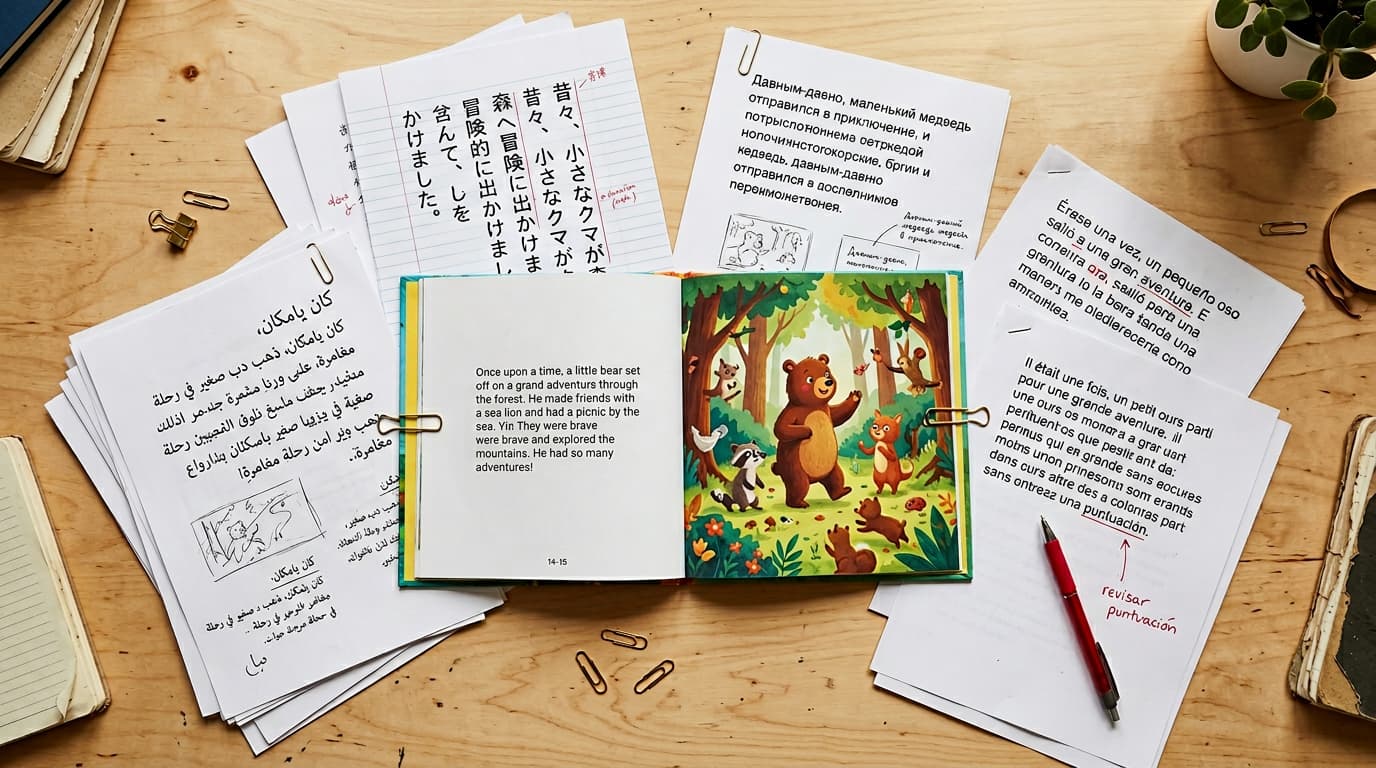
What it actually costs to translate a children's book into 10 languages
Translation comes up early in the picture book author's journey. You have a story that works. The illustrations are universal. You start to wonder: couldn't this reach kids in Germany, or Japan, or Brazil?
The answer is yes. Then you look into what it costs, and the conversation usually ends there.
This post gives you the real numbers so you can make an informed decision.
What translation actually costs
Literary translation for children's books is specialized work. A picture book isn't a technical manual. The translator needs to understand rhyme and rhythm if the original has them, preserve the warmth and voice of the story, handle names and cultural references thoughtfully, and write at the right vocabulary level for young readers.
This is skilled work, and it's priced accordingly.
For a standard picture book (around 500 to 1,000 words of text), here are realistic translation costs by language pair from English:
Spanish: $300 to $600. One of the more affordable pairs due to the large pool of qualified translators.
French: $350 to $700.
German: $400 to $800.
Japanese: $600 to $1,500. Specialized market, fewer translators, higher rates.
Arabic: $500 to $1,200. Significant variation based on dialect (Modern Standard vs. regional).
Turkish, Polish, Finnish: $400 to $900 each. Smaller translator pools mean less price competition.
Persian (Farsi): $500 to $1,100.
These are translation only. They don't include proofreading by a second native speaker, which is strongly recommended. Add $100 to $300 per language for that.
They also don't include layout. If your picture book has text embedded in illustrations, each language requires a redesigned layout. Budget $200 to $500 per language for a professional layout pass.
The narration question
A translated text is one thing. A narrated story is another.
For young children, especially those learning or maintaining a heritage language, hearing the story read aloud by a clear, expressive voice is a significant part of the value. A translated ebook without narration is a lesser product for this audience.
Professional narration for a picture book runs roughly $200 to $500 per finished hour of audio, per language. A picture book read-through with natural pacing is typically 8 to 15 minutes of finished audio.
At the lower end: $100 to $200 per language for narration alone.
At the upper end, with studio time and editing: $400 to $700 per language.
That's before sourcing narrators, managing files, and handling post-production editing for each language.
The full math for 10 languages
Let's build a realistic budget for translating and narrating a picture book into 10 languages.
Translation (x10 languages): $4,000 to $10,000
Second-reader proofreading (x10): $1,000 to $3,000
Layout redesign (x10): $2,000 to $5,000
Narration (x10 languages): $1,000 to $7,000
Total: $8,000 to $25,000.
This assumes you already have a finished, professionally produced original. It doesn't include distribution, platform fees, or marketing in those new markets.
For most independent authors who've already spent $6,000 to $10,000 producing the original, this budget is out of reach.
What this gap means for multilingual families
The cost structure above isn't just a problem for authors. It's a problem for readers.
Multilingual families, those raising children with two or more languages at home, are one of the most motivated audiences for children's stories. They want their children to hear their home language spoken beautifully, to fall in love with stories in Turkish or Finnish or Persian. They're actively looking.
And they're not finding much. Because the economics make it nearly impossible for most authors to get there.
The result is a market where English-language children's content is abundant and high-quality, and content in most other languages is scarce, expensive to source, and often amateur in production.
A different cost structure
The numbers above assume you're paying for translation and narration yourself, upfront, before a single copy sells in that language.
That's the traditional model. It's also why it almost never happens.
A different approach inverts the cost structure: translation and narration are funded by the platform, in exchange for a revenue share on reads. The author pays nothing upfront. The platform earns when the author earns.
This is how Redda works. Authors upload their original manuscript. Redda handles translation into 28 languages, quality narration in every language, and distribution to multilingual families who are actively looking for exactly this content. No upfront cost. Revenue share on every read, in every language.
The total cost to the author of reaching 28 languages: zero.
The math changes completely when the structure changes.
For a full breakdown of the traditional publishing economics, including royalty rates and the discovery problem, see The real economics of self-publishing a children's picture book.
Publish your story in 28 languages at no upfront cost. Learn more at reddastories.com/for-authors.
Sources: Translation rate ranges based on ProZ.com community rate surveys and the American Translators Association rate guidance for literary translation. Narration cost estimates based on ACX marketplace data and independent studio rates.