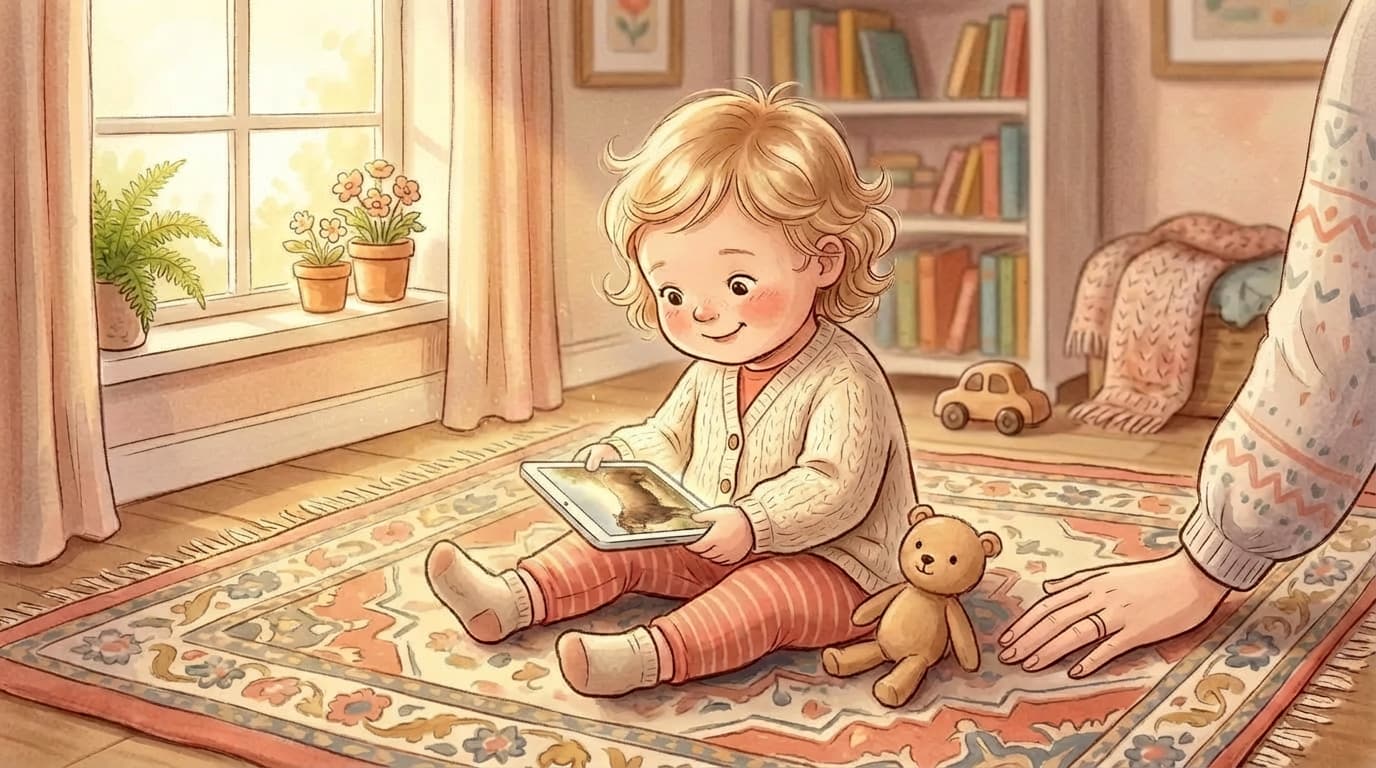
Your toddler is getting 2 hours of screen time a day. Here's how to make 10 minutes of it count.
If your two-year-old watches about two hours of screens a day, you're not doing something wrong. You're doing something normal. A UCL study tracking more than 8,000 families across England found that 98% of two-year-olds use screens daily, averaging just over two hours. Two hours is the number. Most families are at two hours.
And yet, most of the conversation around screen time is still built around guilt. Cut back. Set limits. Protect their developing brains. All of it aimed at a number that most families aren't hitting.
There's a quieter finding buried in this research that deserves more attention: it's not the hours that predict outcomes. It's what happens inside them.
The finding that changes the conversation
The UCL study looked at vocabulary scores, emotional development, and behavioral patterns across thousands of children. Heaviest screen users (around five hours a day) scored meaningfully lower on vocabulary tests and were twice as likely to show emotional difficulties. That finding gets all the headlines.
But here's what doesn't: children who scored highest on vocabulary tests weren't necessarily low screen users. They were children whose parents read with them, played with them, and engaged with them. Parental engagement was a stronger predictor of language development than screen time itself.
A companion study from the Education Policy Institute found something similar in babies as young as nine months. Moderate screen use (up to two hours a day) showed no reduction in story-sharing, pretend play, or singing compared to families with zero screen time. The negative associations only appeared above two hours, and even then, the researchers were careful about what they attributed to screens versus other factors in those families' lives.
Dr. Tammy Campbell, EPI's Director for Early Years, put it plainly: "A large part of the conversation needs to shift from 'how much' to 'what,' and 'why.'"
That shift matters for parents. Because the honest question isn't whether your child is watching screens. They are. The honest question is: what are they watching, and what does it do for them?
What makes screen time developmental
The research points to a few consistent markers. Screen time associated with better outcomes tends to be:
Shared. A child watching alone, passively, absorbs less. A child watching with a parent who pauses, points, and talks about what's happening absorbs significantly more. Co-viewing turns a passive experience into a conversational one.
Interactive. Content that invites a response, asks a question, or highlights what's being said (so a child can follow along) activates different cognitive processes than background TV.
Short and story-shaped. A picture book takes five to ten minutes. It has a beginning, a middle, and an end. A child who finishes a story has experienced narrative closure. That's developmentally different from an episode that flows into another episode, and another.
Language-rich. Vocabulary acquisition in early childhood is almost entirely about exposure. Children learn words by hearing them, repeatedly, in context. A story narrated by a clear, expressive voice builds word recognition in ways that visual-only or music-only content doesn't.
None of this is a secret. It's what narrated stories have always done. The screen isn't the problem. The question is whether what's on it does any of these things.
The 10-minute window
You don't need to overhaul anything. Two hours of screen time is two hours. But somewhere inside those two hours, there are probably ten minutes that could do something more.
Ten minutes is a picture book. It's a narrated story with word-level highlighting that lets a small child hear a word and watch it light up at the same moment. It's a story in the language your family speaks at home, or in the language you're hoping your child will grow up knowing.
Ten minutes of that isn't screen time in the way a pediatrician worries about screen time. It's a narrated story on a screen. And the research, honestly, doesn't distinguish between a story narrated from a page and a story narrated from a device. What it distinguishes is passive and interactive. Alone and shared. Narratively empty and narratively complete.
Your child is already getting two hours. You don't need to feel worse about that. You just need ten of those minutes to do something.
A note on multilingual families
One piece of the UCL data that received almost no coverage: the income gap in reading rates is enormous. Among affluent families, 77% of toddlers are read to daily. Among disadvantaged families, 32%.
Language is bound up in that gap. Families who don't read in English, who can't easily access English-language apps, who want their children to hear their home language spoken beautifully and with real expression, have almost nothing built for them. The children's content ecosystem is, with rare exceptions, an English-language ecosystem.
If your family speaks Turkish, or Finnish, or Persian, or Arabic at home, finding a narrated story in your language is genuinely hard. Finding one that's beautifully made, age-appropriate, and available on a device your child can use is close to impossible.
That gap is real. And it matters, because the research is clear: hearing language spoken fluently and expressively, in context, is how children acquire it. That's true in English. It's true in every language.
What to look for
If you're thinking about what those ten minutes should look like, a few things to prioritize:
- Quality narration. Expressive, warm, and clear. Children respond to how a story sounds, not just what it says. Flat or robotic narration doesn't hold their attention. A voice that reads with feeling does.
- Word highlighting. When the word lights up as it's spoken, the brain makes a connection between the sound and the text. This is pre-literacy in action.
- Stories your child wants to hear again. Re-reading is not a sign of boredom. Repetition is how young children consolidate language. If they want the same story three nights in a row, that's working.
- No ads, no autoplay, no infinite scroll. The screen time that worries researchers is the kind that keeps going. A story ends. That ending matters.
- Your language. If you speak a language other than English at home, find content in that language. Your child's brain is building two vocabularies at once. Feed both of them.
Two hours of screen time is where most families are. You don't need to feel bad about that number. You just need ten of those minutes to count.
Redda is a narrated library of children's stories in 28 languages, designed for the kind of reading this research describes. reddastories.com
Sources: UCL, "Toddlers spending two hours on screens a day," January 2026. Education Policy Institute, "Babies and screen time," March 2026.